
If most of your bills are in one local currency and you plan to stay, use the spending currency. If you move often or save in the income currency, use the income currency. The main thing is to pick one and stick with it, so months stay comparable.
No. Moving your own money from one currency to another isn't spending. Only the difference you lose on the exchange, or a fee you pay, is an expense. Log that separately, for example under fees.
If your income and spending are in different currencies, exchange rates move the numbers. The same rent in tenge costs more or fewer dollars from month to month. That's why a small buffer for rate swings helps.
No. This guide is about tracking and planning everyday spending. For taxes on foreign income, residency or reporting rules, talk to a local tax adviser.
Log a purchase in any currency in a few taps and see everything in your own currency. Free to start.
When you earn in one currency and spend in another, budgeting gets confusing fast. The fix is simple: pick one main currency for your budget, log every purchase in the currency you actually paid, look at the numbers once a month, and keep a small buffer for exchange-rate swings.
Imagine you're paid in US dollars, but rent, groceries and the gym are in tenge. Every month you exchange some dollars. Rent is the same 250,000 tenge, but in dollars it costs a little more one month and a little less the next.
So which number is your rent? And did you spend more this month, or did the rate just move? Without a clear system, the answers get blurry. Below is the system that works.
Your main currency is the one your budget is counted in. Totals, limits and charts all use it. There are two sensible choices.
The currency you earn in. It makes sense if you move between countries, save in that currency or plan to leave. You'll see clearly how much of your income each month takes.
The currency you spend in. It makes sense if you've settled down and most bills are local. Budgets for rent and groceries stay round and familiar, and rate swings show up on the income side instead.
There's no wrong answer. What matters is choosing once. If you switch every few months, you can't compare one month with another.
Type the amount from the receipt, in the currency on the receipt. Don't convert it in your head first. Mental maths is slow, and it hides what you actually paid.
A good multi-currency app converts the amount for you and keeps both numbers. In Delve, a multi-currency expense tracker, you pick the currency next to the amount, and the purchase appears in your totals in your main currency.
Exchanging your own dollars into tenge isn't spending. The money is still yours, just in another currency. If you log the whole exchange as an expense, your month will look far more expensive than it was.
What is an expense is what you lose along the way:
Log these as a separate expense, for example under "Tax & Fees". After a few months you'll see how much exchanging money really costs you, and whether another card or bank would be cheaper.
Pick a fixed day, for example the first weekend of the month. Spend fifteen minutes on three questions.
The third question matters most when you live across currencies. It stops you from cutting spending that didn't actually grow.
Exchange rates move, sometimes sharply. If your income and spending are in different currencies, a bad month for the rate can eat into your plans.
A simple rule: keep 5–10% of your monthly spending as a buffer. If you're paid in dollars and spend about 1,000 dollars' worth of tenge a month, set aside 50–100 dollars. In a good month for the rate, the buffer grows. In a bad one, it covers the gap.
The numbers below are illustrative. For simplicity, say 1 dollar is 500 tenge.
Aida works remotely and is paid 2,000 dollars a month. She lives in Almaty and chooses tenge as her main currency, because almost all her bills are local.
| What | Paid in | Amount | In tenge |
|---|---|---|---|
| Rent | Tenge | 250,000 ₸ | 250,000 ₸ |
| Groceries and cafés | Tenge | 180,000 ₸ | 180,000 ₸ |
| Software subscriptions | Dollars | $40 | 20,000 ₸ |
| Exchange fee | Tenge | 6,000 ₸ | 6,000 ₸ |
| Total spent | 456,000 ₸ |
Her income is 2,000 dollars, or 1,000,000 tenge at this rate. She spent 456,000 tenge, so she kept about 54% of her income. Next month the rate moves to 480 tenge per dollar. Her spending in tenge is the same, but her income is now worth 960,000 tenge. Her savings rate drops a little, and her buffer covers it. She doesn't need to cut groceries, because her habits didn't change.
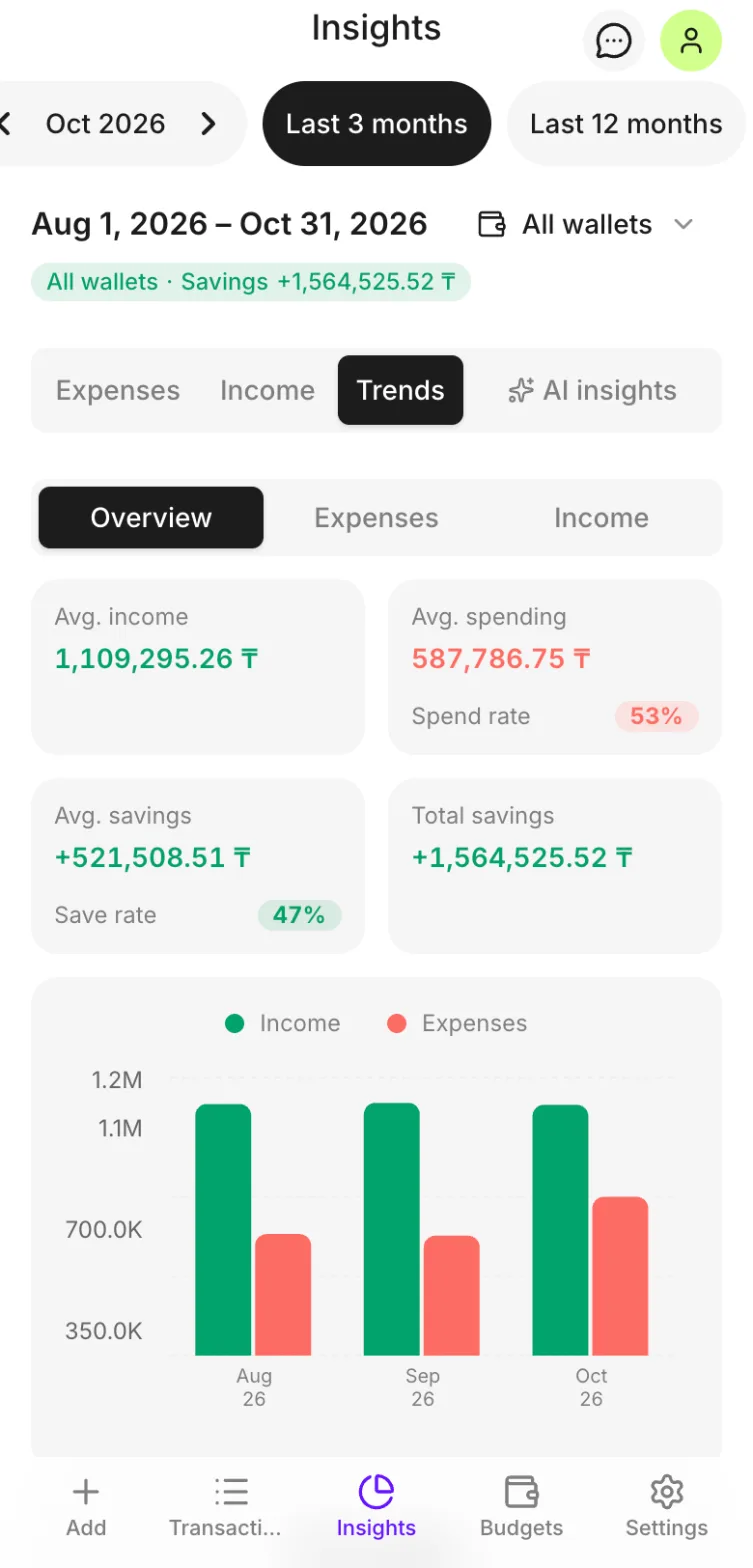
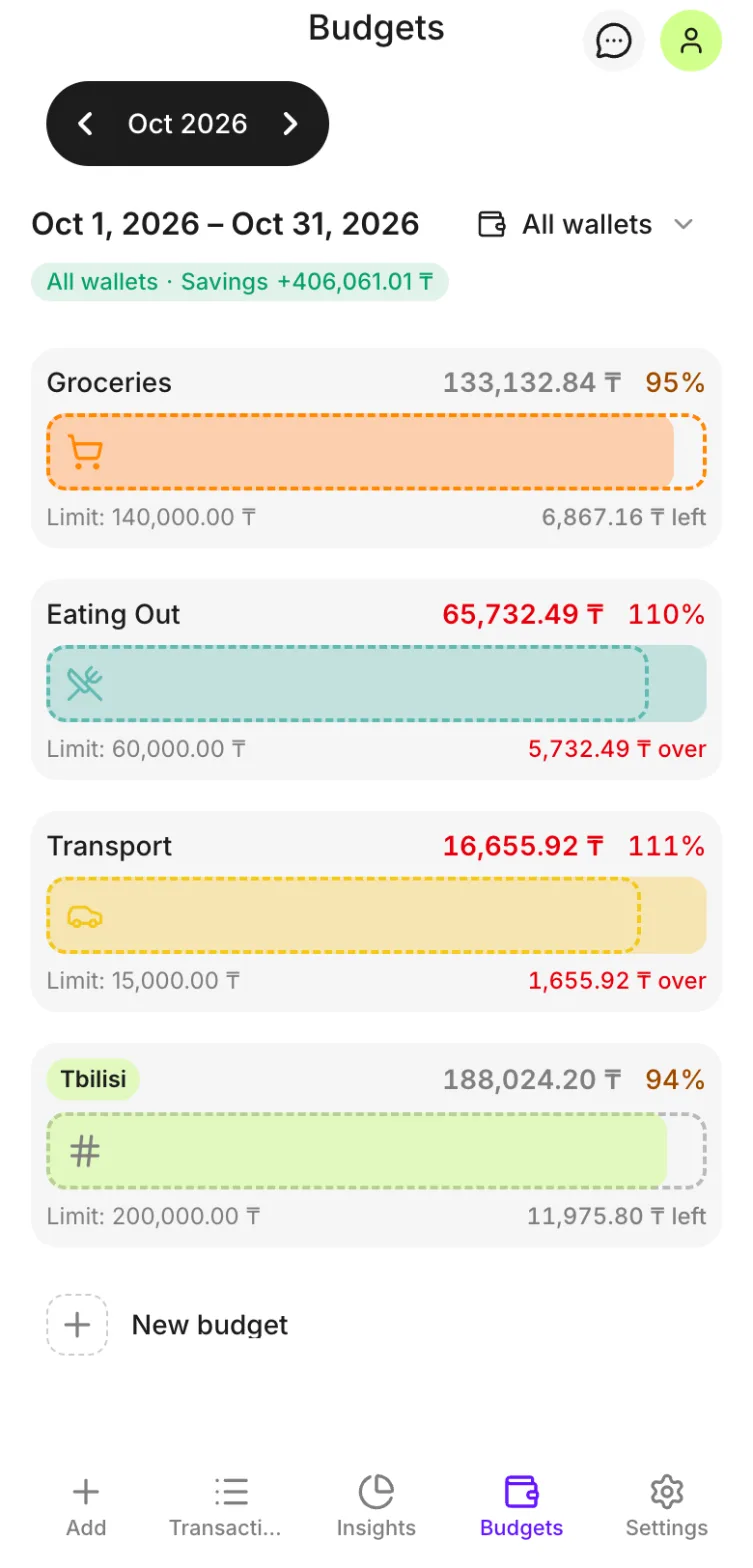
A spreadsheet works if you're disciplined, but you'll be typing exchange rates by hand. An app made for several currencies saves that step: it converts each purchase at the rate for its date and keeps your totals in one currency. Here's how that works in Delve.
This guide is about everyday budgeting, not taxes. For questions about taxes on foreign income or residency rules, talk to a local tax adviser.
Key takeaways
